Base 9 - The Sharks
Welcome to Base 9’s webpage.
Mr Hale would like to welcome you to our class home page. Here you will be able to find out about what we have been learning and planned future activities. You will be able to view homework activities for the week along with the spelling and times tables focus.
In Base 9 we view learning as a journey and along the way it might be tricky, but we are learning to view problems as a challenge to be conquered rather than an obstacle in our path.
We hope you visit our webpage regularly for updates on how we are growing as learners and to see some of the fun learning opportunities that we have been taking part in.
Value of the season
Our value of the Month for Summer is Courage . We will be looking for ways we can show courage and why it's important to be brave and show courage. In class, we will be thinking about how we are courageous and why this is important . We will also be looking at how to be courageous both in and out of school.
History
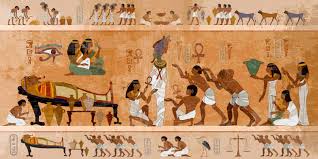
This term our topic is the Ancient Egyptians.
Throughout this topic, the children will focus on answering the big question ' What has Ancient Egyptian civilisation given to todays world ? '. We will also be delving into the wonderous world of the ancient Egyptians.
The Ancient Egyptians were one of the earliest and most influential civilizations in human history, thriving along the Nile River in northeastern Africa for over 3,000 years (around 3100 BCE to 30 BCE).
Life Along the Nile

The Nile River was the heart of Egyptian life. Its annual flooding deposited fertile soil, making agriculture possible in an otherwise desert landscape. Egyptians grew crops like wheat and barley and relied heavily on predictable seasons.
Society and Government


Egyptian society was highly structured:
- At the top was the pharaoh, considered a divine ruler.
- Below were priests, nobles, and officials.
- Artisans, farmers, and laborers made up most of the population.
The government was centralized, and the pharaoh controlled laws, taxes, and religious practices.
Religion and Beliefs


Religion was central to daily life. Egyptians believed in many gods (polytheism), including:
- Ra (sun god)
- Osiris (god of the afterlife)
- Anubis (god of mummification)
They believed in an afterlife and practiced mummification to preserve bodies for the next world.
Pyramids and Architecture

The Egyptians built monumental structures, including:
- The pyramids, especially the Great Pyramid of Giza
- Temples and statues like the Sphinx
These structures showcased advanced engineering and were often built as tombs for pharaohs.
Writing and Knowledge

The Egyptians developed a writing system called hieroglyphics, using symbols to represent sounds and ideas. They wrote on papyrus and recorded everything from religious texts to administrative records.
Reading
Our love to read book in Summer 2 is the Nowhere Emporium . The children have expressed their excitement to read this book. For our reading for pleasure at the end of the day we are going to be continuing with our 10 of the term.
Science
In Science during summer one we have learnt all about the light, . We have learnt how light travels, what are light sources and how shadows are formed . In Summer two, we will be building on our knowledge of the world around us to explore earth and space. We will be looking at the different planets and our solar system
Art
In art, this term we have been learning about architecture. We have looked at different building designs and how to use perspective to make architectural drawings. We have then moved onto making our own houses using foam blocks.